
Browse by Theme: Reviewed 2021
Banking on Change 2 pager
November 2009
Banking on Change is a partnership with Barclays, Plan and Care Internationa that focuses on savings-led community finance initiatives which are effective in meeting the needs of the poor – providing a way to manage their money and increase their ability to deal with life emergencies. The partnership has 3 main objectives inclusion; outreach and impact.
Read more...Pastoralists’ vulnerability in the Horn of Africa
November 2009
Exploring political marginalisation, donors’ policies and cross-border issues – Literature review.
The Humanitarian Policy Group (HPG) at the Overseas Development Institute (ODI) was commissioned by CARE International (CARE) to provide a review of the literature on the nature of pastoralists’ vulnerability in the Horn of Africa (focusing specifically on Kenya, Somalia and Ethiopia) and chart ways in which agencies have responded and identifying best practice. This literature review is part of a broader project that HPG is undertaking to provide learning support to CARE and document and strengthen best practices around drought cycle management in the Horn of Africa (HoA).
Humanitarian Implications of Climate Change - Mapping emerging trends and risk hotspots
November 2009
Human-induced climate change is modifying patterns of extreme weather, including floods, cyclones and droughts. In many cases, climate change is making these hazards more intense, more frequent, less predictable and/or longer lasting. This magnifies the risk of “disasters” everywhere, but especially in those parts of the world where there are already high levels of human vulnerability.
Read more...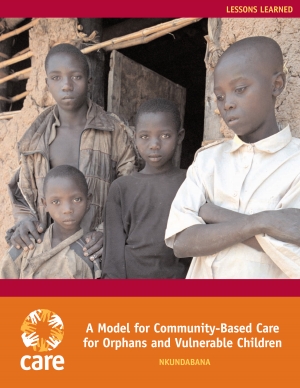
CARE Rwanda’s Nkundabana (Kinyarwanda for 'I love children') approach provides a community-based solution to child-headed households and households where adults are unable to provide adequate care for children.
The Nkundabana model mobilizes adult volunteers from the community to provide guidance and care for children living in households without adult support.
The Nkundabana model provides a foundation for economic and food security as well as child advocacy.
The model also has excellent potential for long-term sustainability because the community is supported to work together to care for the children themselves.
This document summarizes the lessons learned through CARE’s experience in developing an HIV and AIDS workplace policy.
Read more...
There is a strong two-way relationship between food insecurity and the HIV and AIDS epidemic.
Homestead gardening can help to break the connection. It offers a wider range of potential crops than field-based agriculture, requires less time and labour and can provide a source of extra income.
Mainstreaming HIV and AIDS concerns into agricultural programs also helps reduce stigma and build partnerships with other organizations.
Food, nutrition and HIV
October 2009
May 21, 2007 – Brussels, CARE held a second roundtable meeting in cooperation with WFP and UNAIDS to discuss the links between food insecurity and HIV and AIDS.
Practitioners from Rwanda, Ethiopia and Zambia shared experiences in HIV and food security programming and provided tools for policy makers and programmers in Europe.
In 2007, we are one year into the “scale up” to universal access to HIV/AIDS prevention, treatment, care, and support, and as we approach the half way point to the Millennium Development Goals, it is an appropriate time to take stock of a comprehensive approach.
This second roundtable builds on last year’s discussion, which brought together high-level representation from the European Commission, relevant UN agencies, the European Parliament and the NGO community to share ideas about how to create greater linkages in this area and optimise the impact of existing interventions.
