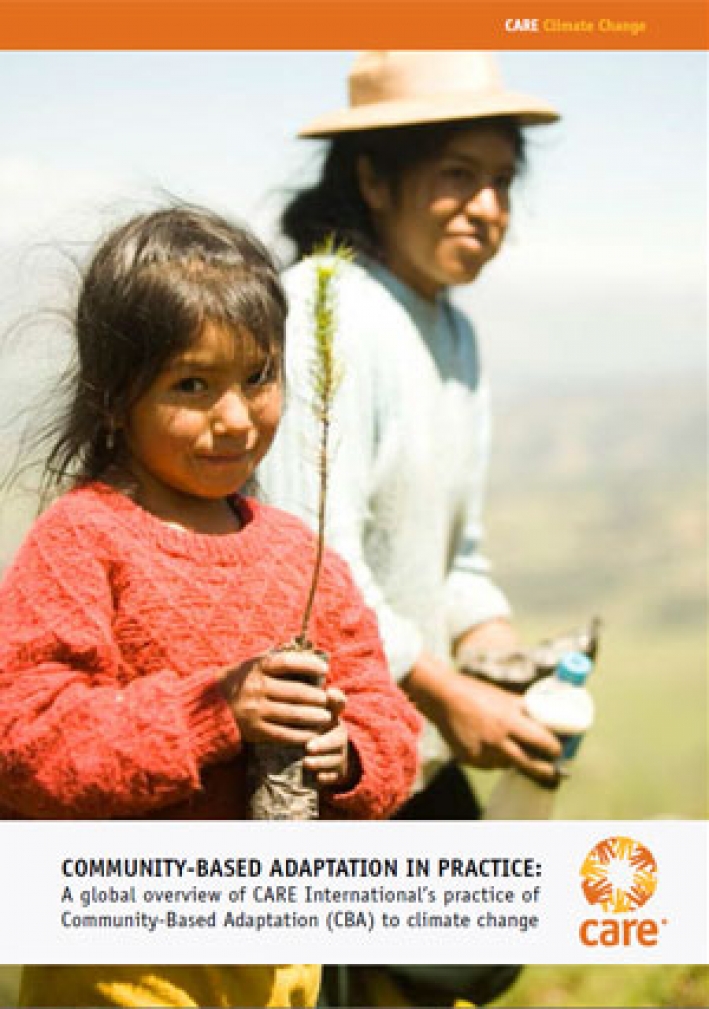
Community-Based Adaptation in practice: A global overview of CARE’s practice of Community-Based Adaptation (CBA) to climate change

This report outlines the practical lessons learned by CARE about Community-Based Adaptation (CBA) to climate change, and explores how elements of the approach are evolving and being integrated into other development sectors.

Drawing on analysis of 16 CBA project examples from Africa, Asia, and Latin America and the Caribbean, the report presents case studies illustrating the four main strategies of CARE's CBA framework: promotion of climate-resilient livelihoods; disaster risk reduction; local capacity development; and advocacy and social mobilisation. The report also looks at the bigger picture of CBA in practice, including: an economic rational for CBA; CBA, food security and migration; joint principles for adaptation (including a tool that can link CBA activities to national-level advocacy); and working in an NGO consortium. It concludes by consolidating the good practice lessons learned and drawing out the implications for practitioners and for CARE's climate change tools and resources.

  • Countries: Bangladesh, Cuba, Ecuador, Ethiopia, Kenya, Mozambique, Nepal, Nicaragua, Niger, Peru, Thailand, Viet Nam, Global
  • Published: June 2014

Related Publications

International Development Committee Inquiry into the progress the Government has made at putting climate change at the centre of aid policy: Written evidence by CARE International UK

CARE International UK’s submission to the International Development Committee Inquiry argues that, in order to deliver on its commitments to increase climate finance, ensure 50% is directed for adaptation, and to increase gender-responsiveness,... Read more...


Every Voice Counts: Domains of change research

This report presents a review of experiences from the Every Voice Counts (EVC) programme, an inclusive governance initiative implemented by CARE Nederland and partners from 2016 to 2020. The overall objective of the programme was to... Read more...


‘If we don’t work, we don’t eat’: Syrian women face mounting food insecurity a decade into the conflict

After 10 years of conflict and humanitarian crisis in Syria, this research seeks to better understand Syrian women’s experiences during the past decade, with a focus on how their lives have changed, the livelihoods strategies they have... Read more...


Stop Telling Half The Story: The UK government must deliver on women’s leadership in 2021

Women and girls’ priorities must be central to crisis response, and the best way to make this happen is to have them lead efforts to prevent and respond. This briefing paper sets out how and why the UK in 2021 must be a global champion for... Read more...


Climate Adaptation Finance: Fact or Fiction?

This report shows that rich nations and institutions have been routinely over-reporting funding for developing countries to adapt to the climate crisis. This means that the world’s most vulnerable people and countries are only receiving a... Read more...


Beyond economic empowerment: The influence of savings groups on women's public participation in fragile and (post) conflict-affected settings

Research shows that in addition to improving income and access to savings, women’s participation in savings groups also improves their confidence, skills and ability to influence household decision-making. This prompts the question: do these... Read more...


The 10 most under-reported humanitarian crises of 2020

CARE’s annual report highlighting the 10 most under-reported humanitarian crises of the year. The analysis reveals a concerning trend of crises – particularly on the African continent – being neglected year after... Read more...


Opening open government: Women’s rights organisations and the Open Government Partnership in the Philippines

This research was funded by the Feminist Open Government Initiative, which uses research and action to encourage governments and civil society to champion initiatives leading to gender advancements in and through open government. This includes... Read more...


Sometimes we don’t even eat: How conflict and COVID-19 are pushing millions of people to the brink

This CARE report exposes how COVID-19 has exaggerated food insecurity in conflict-torn regions including Yemen, South Sudan, northeast Nigeria, and Democratic Republic of Congo. The report argues that unless urgent action is taken, repercussions... Read more...


Building Forward: Creating a more equitable, gender-just, inclusive and sustainable world

The effects of the COVID-19 pandemic have undoubtedly been, and continue to be, terrible for individuals, communities, and countries. Yet the crisis provides the world with a unique opportunity, an opportunity to build forward rather than back.... Read more...