
Development Blog
UK aid and the role of business – will it deliver economic empowerment for women?
By Laurie Lee 12th Oct 2018
The UK government is increasingly highlighting the link between business and UK aid, and the need for aid spending to benefit the UK. For us at CARE the primary question has to be: does it economically empower poor women?
Read more...
 Members of the Chadongo women's group in Malawi who have received business loans through Lendwithcare.org
Filling the health human resource gap through public-private partnership: What we know from Bangladesh
By Anne Laterra 12th Oct 2018
Today, at the 5th Global Symposium on Health Systems Research in Liverpool, UK, I’m presenting key learning from CARE’s highly successful and Global Good Award winning Private Community Skilled Birth Attendant (P-CSBA) programme in Bangladesh, part of CARE and GSK’s…
Read more...
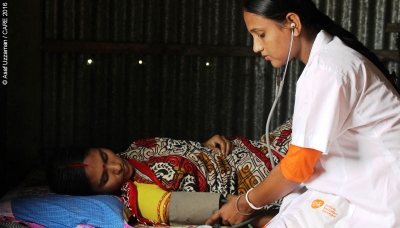 Champa Rani, a Private Community Skilled Birth Attendant, provides Sharker with ante-natal care in Sunamganj
For the people we work with and for, the divisions and brick walls between humanitarian and development work do not make sense. So why does the sector keep this division as the norm, rather than the exception?
Read more...
 Two members of this Faquaa (North of West Bank) women's group, which led socio-economic improvements for their community, were elected as local council representatives
5 Minute Inspiration: How vocational training helps Syrian refugees feel safer
By Emily Janoch 02nd Oct 2018
Syrian refugees in Jordan are learning new skills and building networks so they feel safer. Jordan’s urban protection response programme provided vocational training to both refugees and the Jordanian host community. 84% of participants say the project has improved their…
Read more...
 Woman participating in sewing course, Jordan.
Conflict-related violence against women and girls: What we know from South Sudan
By Dorcas Acen 27th Sep 2018
‘Rape against women and girls is common during the crisis. This is done by both soldiers and civilians.’ This quote comes from just one of the many women who have endured sexual violence in South Sudan – and in my…
Read more...
 An internally displaced woman in South Sudan
How VSLAs help ensure that financial inclusion is gender transformative
By Gerry Boyle 26th Sep 2018
Village Savings and Loan Associations (VSLAs) have been a cornerstone of CARE International’s programmes for over 25 years, and we have plenty of evidence of their ability to impact women’s lives positively. However, we have also learned that gender norms…
Read more...
 Members of a CARE-supported VSLA group in Kagadama village in Niger
